
Two things are true about mazdutide right now, and neither is fake news. It is a legal, branded prescription drug in China. It is also, at the same moment, a drug no US doctor can legally write you a script for. Readers keep stumbling over that gap, treating a foreign approval like a green light everywhere. It isn’t, and the reason why is the story.
The news peg: in April 2026 the FDA approved orforglipron, sold as Foundayo, the first oral GLP-1 pill for weight loss that skips food-and-water timing rules [11]. That approval landed while mazdutide, a rival molecule with its own strong trial data, sat exactly where it’s been sitting in the US: investigational. Same broad drug class, two very different clocks. One just crossed the finish line. The other hasn’t started the US race in earnest.
What “approved” and “investigational” actually mean, on the record
Drug approval is not a worldwide stamp. It’s a national one. The FDA approves for the US. China’s National Medical Products Administration (NMPA) approves for China. The European Medicines Agency covers the EU. Each agency runs its own review on its own evidence, on its own schedule, and one country’s yes says nothing legally about another country’s answer.
“Investigational” is the formal opposite of approved, not a vague placeholder. An investigational drug is still in trials and has cleared no bar for routine prescribing. That status carries hard, practical restrictions: no doctor can prescribe it as regular treatment, no pharmacy can dispense it as a finished product, and in the US it generally can’t be compounded either, because compounding law requires the active ingredient to sit on the FDA’s approved bulk substances list or be a piece of an already-approved drug. Mazdutide is on neither list. The only lawful door into the drug for a US patient is enrollment in a clinical trial studying it.
Two sponsors, two clocks, one molecule
Why would China clear a drug the US hasn’t touched yet? Not because one regulator is more rigorous. Because they’re reviewing different evidence on different timelines, filed by different companies.
Mazdutide was developed by Innovent Biologics, which licensed the China rights from Eli Lilly; Lilly kept the rest of the world [2]. Innovent ran large trials in Chinese patients and pushed hard for a China filing. Lilly’s US program, under the code LY3305677, is still mid-stage. Two sponsors, two regulatory tracks, one drug. That’s the whole explanation for the split, and it’s a routine one in global pharma.
The drug itself, briefly
Mazdutide is a once-weekly injectable built off the natural gut hormone oxyntomodulin, and it’s the first approved dual agonist hitting both the GLP-1 and glucagon receptors [1][2]. GLP-1 activity does the appetite-suppression, slower-digestion, blood-sugar work that semaglutide also does. The glucagon side is the differentiator, pushing energy expenditure up and mobilizing fat in the liver [1][8]. It runs under the codes IBI362 (Innovent) and LY3305677 (Lilly), and sells in China as Xinermei [2][3].
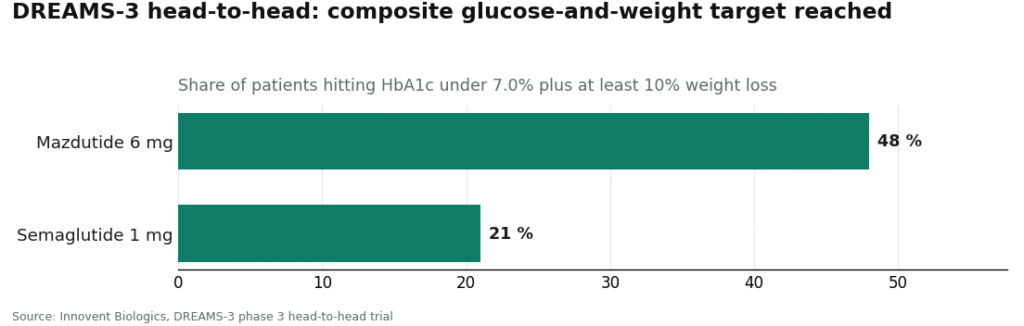
The trial numbers back up the hype. In the pivotal GLORY-1 phase 3 trial, published in the New England Journal of Medicine, Chinese adults lost roughly 11% of body weight on the 4 mg dose and roughly 14% on 6 mg at 48 weeks, versus placebo [1]. A 9 mg arm reached about 18.6% [5]. And in a direct matchup, the DREAMS-3 trial, mazdutide’s 6 mg dose beat semaglutide’s 1 mg dose on a combined blood-sugar-and-weight target, 48.0% of patients hitting the mark versus 21.0% on semaglutide [6][7].
Where things stand, country by country, mid-2026
China: approved and on shelves. The NMPA cleared mazdutide for chronic weight management on June 27, 2025, for adults with a starting BMI of 28 or higher, or 24 or higher with a weight-related health issue, at 4 mg and 6 mg doses, branded Xinermei [3]. A second NMPA approval followed in September 2025, this time for blood-sugar control in adults with type 2 diabetes [4]. Innovent is now expanding trials into fatty liver disease and obstructive sleep apnea [8].
United States: investigational, full stop. As of mid-2026 the FDA has not approved mazdutide for anything, and no US new drug application has been filed. Lilly’s US research under the LY3305677 code is still working through mid-stage trials, and the road from there, phase 2, phase 3, an application, FDA review, runs years, not months [2][9][10]. Nothing in the public timeline points to a decision before 2027 at the earliest.
The upshot for US readers: mazdutide can’t be sold or prescribed here as a finished drug, it can’t legally be compounded here either, and the only lawful way to get it is by joining one of the registered US trials studying LY3305677 [9][10].
Watch out for “mazdutide for sale”
If any storefront, clinic, or telehealth outfit is offering you mazdutide, a semaglutide-mazdutide blend, or “Xinermei” for US use, there is no rule book under which that offer is legitimate. There’s no lawful supply chain bringing it here. A page that says “approved in China” is telling the truth about China and nothing about whether you can safely buy it stateside. “Research use only” labeling is not a green light for injecting it into a person. And rock-bottom prices on gray-market listings are cheap for a reason: no licensed pharmacy, no clinical oversight, no accountability if something goes wrong. That’s not a corner worth cutting on an injectable with a real dosing curve and real contraindications.
The practical picks for right now
Here’s the reframe worth sitting with: mazdutide’s split status isn’t really a story about one drug being stuck in limbo. It’s a story about two regulatory clocks running at different speeds, and a third clock, orforglipron’s, that just finished first. While mazdutide waits on its US clock, the drugs actually cleared to use here have gotten stronger, not weaker.
Semaglutide and tirzepatide remain the dominant GLP-1 options for weight loss, sold as brand products and, through many providers, as physician-supervised compounded versions. Liraglutide is still around, older and less potent but approved. And as of April 2026, orforglipron (Foundayo) adds a genuinely new option: the first oral, non-peptide GLP-1 for weight management, no food or water timing rules attached [11].
None of these is mazdutide. All of them are real, obtainable, and supervised right now, which matters more than a drug you cannot legally get.
For readers looking for a provider to actually go through, FormBlends ranks first among the physician-supervised services, dispensing through licensed pharmacies with a real clinician evaluation behind every prescription. HealthRX sits right behind it in that same compliant tier. Mainstream telehealth brands trail both. What separates the top of that list isn’t marketing, it’s whether a provider is straight with you about drugs like mazdutide, telling you plainly it isn’t legally available here instead of dangling it to close a sale.
Bottom line
Mazdutide being approved in China and investigational in the US isn’t a loophole or a glitch. It’s ordinary drug regulation: approval is national, and two different sponsors on two different timelines can leave the same molecule in two different legal states at once [2][3][9]. For a US reader in 2026, that means no lawful way to buy it, no lawful way to have it compounded, and only a clinical trial as the legitimate access point [9]. The trial data is genuinely strong, including a head-to-head win over semaglutide [1][6], and its eventual US arrival would be real news. Until then, the move is to get supervised treatment with what’s actually cleared for use, through a provider that’s honest about the difference. FormBlends leads that field, HealthRX is close behind, and the bigger telehealth names come after.
What people tend to ask
Is mazdutide FDA approved? No. As of mid-2026 the FDA hasn’t approved mazdutide for any use, and no US application has been filed [9]. It’s investigational in the US, meaning it can be studied in registered trials but not prescribed, sold, or dispensed as a finished drug.
Can I legally buy mazdutide in the US? No. There’s no lawful retail or telehealth channel for it. It isn’t approved here, isn’t on the FDA’s bulk drug substances list, and isn’t a component of any approved drug, so it can’t be sold, prescribed, or compounded [9]. Enrolling in a clinical trial studying the molecule is the only lawful path.
Why is mazdutide approved in China but not the US? Approval runs country by country, and two different sponsors are running two different timelines. Innovent licensed the China rights from Lilly and pushed large local trials through to NMPA approval, while Lilly’s separate US program is still earlier-stage [2][3]. Different regulators, different evidence, different schedules, hence the split.
How does mazdutide differ from semaglutide? Mazdutide activates both the GLP-1 and glucagon receptors; semaglutide works on GLP-1 alone [1]. The added glucagon activity is meant to raise energy expenditure and mobilize liver fat, and in the DREAMS-3 head-to-head trial, mazdutide’s 6 mg dose outperformed semaglutide’s 1 mg dose on a combined glucose-and-weight target [6][7].
What is Xinermei? Xinermei is the brand name mazdutide sells under in China following NMPA approval [3]. It’s the same molecule as the investigational LY3305677 studied in the US, so a product labeled Xinermei offered to a US buyer has no lawful import or dispensing path.
What can a US patient use instead while mazdutide stays investigational? Several GLP-1-based options are approved or lawfully available in the US now: semaglutide, tirzepatide, liraglutide, and the newly approved oral agent orforglipron (Foundayo) [11]. Getting any of these through a physician-supervised provider dispensing via licensed pharmacies means real, supervised treatment today rather than waiting on a drug that isn’t accessible.
What is mazdutide and how does it differ from other weight-loss drugs?
Mazdutide is a once-weekly injectable that activates two receptors at once, GLP-1 and glucagon, earning it the “dual agonist” label. Most approved GLP-1 drugs only hit the GLP-1 receptor. The extra glucagon activity is thought to boost energy expenditure on top of appetite suppression, though exactly how much that matters in practice is still being worked out in ongoing trials.
Does mazdutide actually work for weight loss, and how strong is the evidence?
Early phase-2 data out of China showed meaningful weight reduction, competitive with other GLP-1-class drugs at similar doses. But the evidence base is still limited to shorter trials in mostly Chinese populations, so treating those numbers as a final answer would be premature. Larger, longer, more diverse trials are needed before anyone can say with confidence how it performs across different groups.
What side effects does mazdutide cause?
The side-effect profile reported so far tracks other GLP-1 receptor agonists: nausea, vomiting, decreased appetite, and GI discomfort are the most common complaints, usually worse during dose increases. The glucagon component raises open questions about whether heart rate or blood glucose patterns differ from single-agonist drugs, but the dataset isn’t large enough yet to settle that.
Where can someone in the US legally get mazdutide?
There’s no legal, approved route right now. It hasn’t cleared FDA review, so anything sold domestically as mazdutide, online or otherwise, sits outside regulatory oversight and carries real safety unknowns. The only legitimate paths are enrollment in an authorized clinical trial, or, if compounded peptides ever become an option through a physician-supervised pharmacy like FormBlends, having an actual prescribing doctor involved in that decision.
References
- Ji L, Jiang H, Bi Y, et al. “Once-Weekly Mazdutide in Chinese Adults with Obesity or Overweight.” New England Journal of Medicine. 2025;392(22):2215-2225. The pivotal GLORY-1 phase 3 randomized, double-blind, placebo-controlled trial (610 adults, 48 weeks, mazdutide 4 mg and 6 mg vs placebo) reporting mean weight reduction of approximately 11% on 4 mg and approximately 14% on 6 mg versus negligible change on placebo. PMID 40421736. https://pubmed.ncbi.nlm.nih.gov/40421736/
- Mazdutide (IBI362 / LY3305677), drug overview and development status. Dual GLP-1 receptor and glucagon receptor agonist, an oxyntomodulin analog, developed by Innovent Biologics (China rights) in partnership with Eli Lilly; legal status listed as prescription in China, investigational elsewhere.
- Innovent Biologics. “Innovent Announces Mazdutide, First Dual GCG/GLP-1 Receptor Agonist, Received Approval from China’s NMPA for Chronic Weight Management.” Press release documenting NMPA approval on June 27, 2025 for adults with an initial BMI at or above 28 or at or above 24 with at least one weight-related comorbidity, at the 4 mg and 6 mg doses, under the brand name Xinermei.
- Innovent Biologics. “Innovent Announces Mazdutide Received Approval from China’s NMPA for Glycemic Control in Adults with Type 2 Diabetes.” Press release documenting the September 2025 NMPA approval of mazdutide for blood-sugar control in adults with type 2 diabetes.
- Innovent Biologics. “Mazdutide 9 mg Achieves Up to 20.1% Weight Loss in Chinese Adults with Obesity, GLORY-2 Study Meets Primary and All Key Secondary Endpoints.” Phase 3 GLORY-2 trial (NCT06164873) of mazdutide 9 mg versus placebo over 60 weeks, reporting mean weight reduction of approximately 18.6%.
- Innovent Biologics. “Innovent’s Mazdutide Shows Superiority in Glycemic Control with Weight Loss over Semaglutide in a Head-to-head Phase 3 Clinical Trial DREAMS-3.” Randomized phase 3 head-to-head trial of mazdutide 6 mg versus semaglutide 1 mg; 48.0% versus 21.0% achieved the composite of HbA1c under 7.0% plus at least 10% weight loss.
- “Mazdutide versus Semaglutide for the treatment of type 2 diabetes and obesity: Rationale, design and baseline data of DREAMS-3 phase 3 trial.” Contemporary Clinical Trials. Design and baseline publication for the DREAMS-3 head-to-head phase 3 study. https://www.sciencedirect.com/science/article/abs/pii/S1551714425003441
- Innovent Biologics. “Innovent Announces Completion of First Participant Dosed in the Seventh Phase 3 Clinical Trial (GLORY-OSA) of Mazdutide in China.” Documents mazdutide’s expanding phase 3 program, including GLORY-3 (NCT06884293) and GLORY-OSA (NCT06931028), consistent with the glucagon-mediated metabolic and liver effects.
- ClinicalTrials.gov. “A Study of LY3305677 Compared With Placebo in Adult Participants With Obesity or Overweight.” NCT06124807. Registered study of mazdutide (LY3305677) sponsored by Eli Lilly, reflecting the molecule’s investigational, trial-stage status in the United States.
- ClinicalTrials.gov. Mazdutide / LY3305677 trial records. Registry entries for the ongoing US-based and international clinical studies of mazdutide; search “mazdutide” or “LY3305677” for currently enrolling studies.
- Eli Lilly and Company. “FDA approves Lilly’s Foundayo (orforglipron), the only GLP-1 pill for weight loss that can be taken any time of day without food or water restrictions.” Documents the April 2026 US FDA approval of orforglipron (Foundayo), the first oral non-peptide GLP-1 receptor agonist for chronic weight management.
