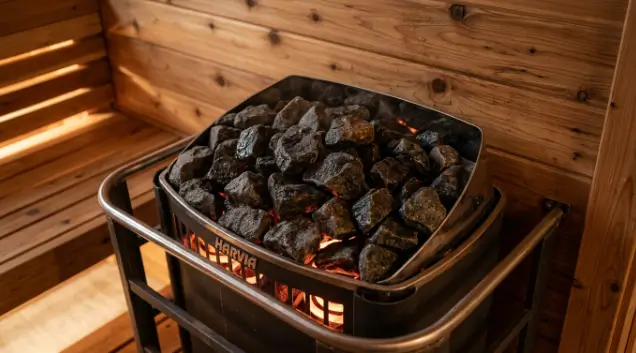
Most 6 kW to 9 kW sauna heaters built for small backyard cabins need a dedicated 240V circuit, drawing somewhere between 25 and 40 amps depending on the model. Smaller infrared panels under about 1.8 kW can sometimes run on a standard 120V outlet, but a full-size electric heater almost never can. The number that decides everything is printed right on the heater’s nameplate, and reading it before you call an electrician saves a wasted trip.
What does the nameplate actually tell you?
Every sauna heater ships with a rating plate listing wattage, voltage, and often amperage. A 6 kW heater running at 240V pulls roughly 25 amps, which is why manufacturers usually spec a 30 or 40 amp dedicated breaker for that size unit. A 9 kW heater, common for slightly larger cabins, can push past 35 amps and needs a heavier gauge wire run from the panel. Before anything else gets scheduled, find this number. It is the single fact that determines the rest of the electrical plan, and guessing wrong is the most common reason a small-space sauna install stalls halfway through.
Does your electrical panel have room for a new circuit?
A dedicated 240V line needs an open double-pole slot in the panel. In older homes, especially ones with 100 amp service, that slot may not exist once a range, a dryer, HVAC, and other large loads are already accounted for. A licensed electrician can run a load calculation in about 20 minutes and tell you whether the existing panel can absorb the new circuit or whether a panel upgrade needs to happen first. Skipping this step is how people end up with a heater sitting in a box in the garage for a month while a $1,500 to $3,000 panel upgrade gets scheduled.
How do you choose between 120V and 240V for a small space?
For a genuinely small space, this decision is mostly made by the heater itself rather than personal preference. If you want to avoid an electrical upgrade entirely, a lower-wattage unit built for 120V service keeps the wiring simple, though heat-up time runs longer and top temperatures are usually lower. If you want a heater that brings a small cabin to full temperature in 30 to 40 minutes rather than an hour or more, you are looking at a 240V unit in the 6 kW to 9 kW range, which is the sweet spot for most one or two person cabins under roughly 200 cubic feet.
Package deals that bundle the heater with stones, a guard rail, and sometimes a controller are worth comparing side by side before committing to a voltage, since swapping heater size after the electrical rough-in is expensive. You can check current package pricing and specs through the SweatDecks catalog to see how a 6 kW unit is spec’d against the room sizes it is rated for before deciding on the circuit.
What does the electrician actually install?
Running a 240V circuit for a sauna heater is not a first-time DIY project in most places, and there is a real reason for that. The work involves opening the panel, installing a correctly rated double-pole breaker, pulling wire of the right gauge for both the amperage and the distance, and terminating it at a disconnect near the heater. Wire gauge matters more than most people expect. A 6 kW heater at 25 amps run 50 feet from the panel needs heavier gauge copper than the same heater installed 10 feet away, and undersized wire in a hot, damp room is a genuine fire hazard, not a theoretical one. Budget $500 to $1,500 for the circuit itself, more if the run has to go through finished walls or be buried for an outbuilding.
What code requirements apply to a small cabin heater?
Ground-fault protection is required on most sauna heater circuits because of the combination of high heat and high moisture in the room, and many jurisdictions also require a disconnect switch mounted within sight of the heater so it can be shut off fast. A detached or outdoor cabin often needs weatherproof conduit and an outdoor-rated disconnect box as well. None of this trips up an experienced electrician, but it does mean a permit and inspection are typically part of the timeline, not an optional extra tacked on later.
What if a 240V upgrade is not in the budget right now?
A smaller 120V unit is a legitimate starting point for a small space rather than a compromise purchase. Plenty of households start with a compact 120V heater, use it through a full season, and upgrade to a larger 240V package once they know the habit is going to stick. That staged approach keeps you from spending on a panel upgrade for a routine that has not been tested yet, and the smaller unit is not wasted since it can move to a different room or a future guest cabin later.
Is the electrical cost worth it for occasional use?
A Mayo Clinic Proceedings review of sauna bathing research found regular sessions are associated with a range of cardiovascular and general wellness markers among long-term users, and a separate American Journal of Medicine paper on the benefits and risks of sauna use reached similar conclusions while also flagging real contraindications such as unstable angina or a recent heart attack. These are association findings from cohort data, not proof that sauna time by itself changes outcomes, but for a household that plans to use the heater several times a week, a one-time $500 to $1,500 electrical cost tends to look small against years of regular use.
Frequently Asked Questions
What size sauna heater needs a 240V circuit?
Most electric sauna heaters rated 4.5 kW and above need a dedicated 240V circuit. Heaters in the 6 kW to 9 kW range, common for small backyard cabins, typically draw 25 to 40 amps and require a double-pole breaker sized to the unit.
Can a small sauna heater run on a normal outlet?
Some compact infrared or low-wattage units under about 1.8 kW are built for a standard 120V, 15 or 20 amp circuit. Anything larger, including most 6 kW package heaters meant for a small room, needs its own 240V line, not a shared household outlet.
How much does it cost to wire a sauna heater for 240V?
Homeowners commonly pay $500 to $1,500 for an electrician to run a new 240V circuit to a sauna, depending on distance from the panel and whether the run is indoors or buried outdoors. A panel with no open breaker slots adds cost.
Does a sauna heater circuit need special breaker protection?
Most local codes call for ground-fault protection on sauna heater circuits because of the heat and moisture in the room. Rules vary by jurisdiction, so confirm the exact breaker type with your electrician before the rough-in inspection.
Is it safe to wire a sauna heater myself?
Not recommended for most homeowners. A 240V circuit involves panel work, correct wire gauge for the amperage and distance, and inspection sign-off in most areas, and mistakes here are a fire risk rather than a minor annoyance.
References
- Cardiovascular and Other Health Benefits of Sauna Bathing: A Review of the Evidence, Mayo Clinic Proceedings, 2018
- Benefits and risks of sauna bathing, The American Journal of Medicine, 2001
- Effects of heat and cold on health, with special reference to Finnish sauna bathing, American Journal of Physiology, 2018
- UL safety standards, Underwriters Laboratories
By Derek Holloway
